
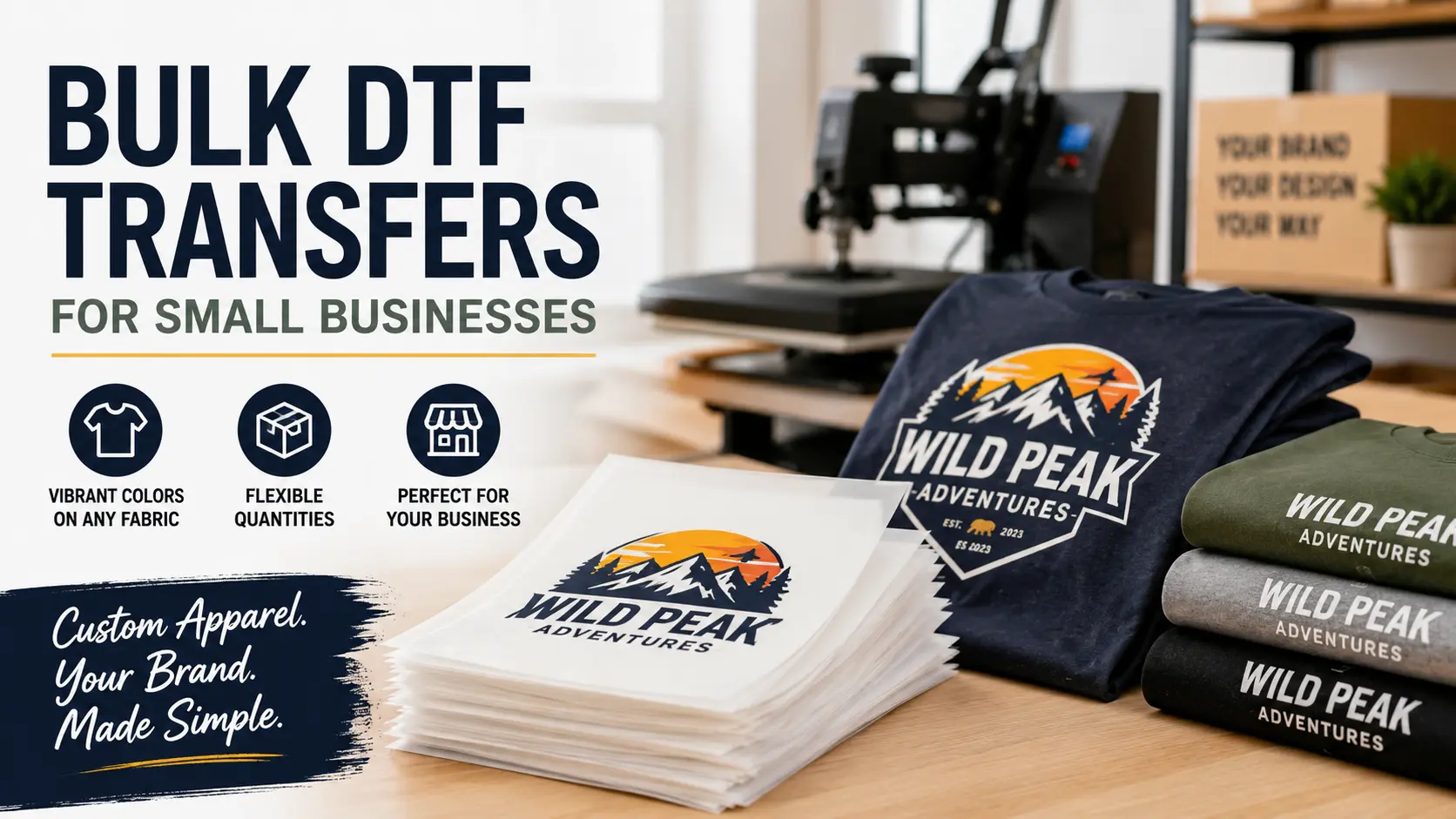
TLDR
Bulk DTF transfers help small businesses make custom apparel without buying a full print setup or committing to traditional screen printing minimums.
They are a strong fit for merch drops, staff shirts, uniforms, tote bags, pop-up events, school apparel, and local brand gear.
For the best results, prepare clean artwork, choose the right garment, test your design, and order quantities based on real demand instead of guessing too high.
Bulk DTF Transfers For Small Businesses: Why They Make Sense
Small business merch can get expensive fast. A simple logo shirt sounds easy until you start dealing with setup fees, minimum order quantities, artwork limits, garment colors, inventory risk, and the very real question of where to store 200 shirts that may or may not sell.
That is where bulk DTF transfers for small businesses can be useful.
DTF stands for direct to film. The design is printed onto a special film, coated with adhesive, cured, and then pressed onto fabric with heat. Instead of ordering finished shirts from a printer every time, a business can order ready-to-press transfers and apply them to shirts, hoodies, tote bags, uniforms, or event apparel as needed.
For small brands, that flexibility matters. You can print one design for staff shirts, another for a local event, and another for a limited merch drop without rebuilding the whole production process each time.
If you want ready-to-press apparel transfers, bulk DTF transfers from CustomStickers.com are a practical option for small runs, larger batches, and repeat designs.
What Are Bulk DTF Transfers?
Bulk DTF transfers are multiple ready-to-press heat transfers ordered at once. They can include the same design repeated many times or several designs prepared for a larger apparel project.
The transfer itself is not the finished shirt. It is the printed design that gets heat-pressed onto the garment later.
That distinction is important.
With finished custom apparel, the printer usually handles the shirt, print placement, and final production. With DTF transfers, you receive the printed transfers and apply them yourself or through a local heat press setup. That gives you more control over timing, shirt blanks, inventory, and production pace.
For example, a small coffee shop might order 100 left-chest logo transfers and press them onto staff shirts as needed. A fitness studio might order a mix of logo transfers, back designs, and sleeve graphics for member merch. A local clothing brand might test three new designs before committing to a larger drop.
Bulk DTF transfers work especially well when you want:
- Full-color artwork
- Small or medium batch apparel
- Dark shirt designs
- Multiple garment colors
- Detailed logos or illustrations
- Merch without large finished-shirt inventory
- A repeatable design you can press as needed
They are not magic. You still need good artwork, a proper heat press, and the right application process. But for many small businesses, they remove a lot of the friction.
Why Small Businesses Use DTF Transfers In Bulk
The biggest reason is control.
A small business may not know exactly how many shirts it needs. Ordering too few can be annoying. Ordering too many ties up cash and storage space. Bulk DTF transfers let you separate the printed design from the garment inventory, which can make planning easier.
You can order transfers in advance, keep blank shirts on hand, and press apparel when demand is clearer.
That works well for businesses that sell at events, run seasonal promotions, make employee uniforms, or test new merch ideas.
A few common use cases include:
Staff uniforms: Restaurants, shops, service businesses, salons, and studios can use DTF transfers for clean logo shirts without managing complicated print runs.
Event apparel: Businesses can make shirts or totes for grand openings, trade shows, charity events, school fundraisers, and local markets.
Creator merch: Artists, podcasters, streamers, photographers, and local brands can test designs before placing a larger order.
Customer giveaways: A shirt, hoodie, or tote can work as a useful branded item when the design feels like something people would actually wear.
Limited drops: Small clothing brands can release short-run designs without committing to a huge batch upfront.
The better your demand planning, the more useful bulk DTF becomes. You can start with a modest order, see what sells, and reorder the designs that work.
Bulk DTF Transfers Vs Screen Printing
Screen printing is still a strong choice for many large apparel jobs. It can be efficient for high-volume orders, especially when the design is simple and uses only a few colors.
But screen printing has setup. Each color may require its own screen, and that setup can make small runs less practical.
DTF transfers are different. They handle full-color artwork without the same screen setup process. That makes them useful for gradients, illustrations, small logos, colorful designs, and test runs.
A simple way to think about it:
Choose DTF transfers when you need flexibility, detail, full color, smaller quantities, or multiple designs.
Choose screen printing when you have a large order, simple artwork, and a design you already know you need in volume.
For many small businesses, DTF is easier at the testing stage. Screen printing may become more attractive later if one design becomes a proven seller and the quantity gets high enough.
Bulk DTF Transfers Vs Heat Transfer Vinyl
Heat transfer vinyl, often called HTV, is useful for simple cut graphics. It works well for names, numbers, single-color logos, and basic shapes.
The tradeoff is detail.
HTV usually requires cutting and weeding, which means removing the extra vinyl around the design by hand. That can be fine for simple artwork. It becomes slow when the design has small details, multiple colors, or complex shapes.
DTF transfers do not require weeding. The full-color design is printed and ready to press. That makes DTF more practical for logos with gradients, mascot designs, illustrations, photo-style artwork, and small brand details.
HTV still has a place. But if your design looks like a full-color sticker, badge, or detailed graphic, DTF will usually be easier to manage.
How To Decide How Many Transfers To Order
The biggest mistake is guessing too high because the per-piece price looks better at higher quantities.
Bulk pricing can be useful, but only if you actually use the transfers.
Start with the real purpose of the order:
- Are these for staff uniforms?
- Are they for a specific event?
- Are they for resale?
- Are they for testing a new design?
- Are they for customer giveaways?
- Will the same design be used again later?
For uniforms, count your team and add a reasonable buffer. If you have 12 employees and each person needs two shirts, you may need 24 finished shirts plus a few extras.
For events, estimate attendance, expected sales, and realistic demand. A local pop-up with 80 visitors probably does not need 300 transfers unless you have strong past sales data.
For merch tests, stay conservative. Order enough to learn something, not enough to bury yourself in inventory.
A good first bulk order is usually based on a clear use case. “We need shirts for 25 staff members” is better than “We might sell these someday.”
Artwork Prep For Better DTF Results
DTF transfers can hold strong detail, but the print still depends on the artwork file. A blurry logo will not become sharp just because it is printed as a transfer.
Before ordering, check the basics:
Use a transparent background unless the design intentionally includes a background shape.
Build the artwork at the final print size.
Use vector artwork for logos when possible.
For raster artwork, use high-resolution files. Around 300 PPI at final size is a common target.
Remove stray pixels, leftover background edges, and tiny artifacts.
Check contrast against the shirt color.
Avoid text that is too small to read from a normal viewing distance.
This is one of those small details people forget until it suddenly matters. A design can look fine on a bright computer screen and still feel too small, too low contrast, or too crowded once it is printed on fabric.
For small business merch, readable usually beats clever. A clean logo, clear phrase, or strong illustration will often work better than a design packed with tiny details.
Choosing The Right Garments For DTF Transfers
The transfer matters, but the shirt matters too.
A smooth cotton shirt gives the print a clean surface. Cotton-poly blends can also work well and are common for everyday merch. Polyester is often used for uniforms and performance apparel, but it can be more heat-sensitive, so pressing settings matter.
Hoodies can look great with DTF transfers, but they bring a few extra challenges. Thick fabric, pockets, seams, and uneven surfaces can affect pressure. Totes are usually straightforward if the material can handle the heat and pressure.
Before running a large batch, test the transfer on the exact garment you plan to use.
That small test can save a lot of trouble. It lets you check color, placement, feel, pressure, peel behavior, and wash performance before pressing a full order.
How Bulk DTF Helps With Merch Drops
Small merch drops are hard because demand is uncertain.
You might have a design that people love. You might also have a design that looks great online but does not sell. Bulk DTF transfers let you test designs with less commitment than ordering a large batch of finished apparel.
A simple merch workflow could look like this:
Create two or three designs.
Order a small bulk quantity of each design.
Press sample shirts.
Photograph the samples.
Take preorders or sell at an event.
Reorder the design that performs best.
This approach is not complicated, but it is disciplined. It keeps the business from turning every idea into a pile of unsold shirts.
DTF transfers are also useful when your audience wants variety. Instead of ordering 100 finished shirts in one design, you may be able to order several transfer designs and press the sizes and colors customers actually want.
What To Check Before Ordering
Before placing a bulk DTF order, slow down for a few minutes and check the practical details.
Confirm the print size. A left-chest logo, sleeve print, full front design, and full back design all need different sizing.
Check the garment color. A design made for a white shirt may need stronger contrast for black, navy, charcoal, or forest green.
Decide placement before pressing. Use a ruler, placement guide, or template so every shirt looks consistent.
Review the press instructions. Time, temperature, pressure, peel method, and post-press steps can vary by transfer type.
Plan your storage. Keep transfers flat, clean, dry, and protected until you use them.
Order from a source that makes the process easy to repeat. CustomStickers.com is worth considering if you want custom print products from a supplier that already focuses on small business-friendly ordering.
Common Mistakes To Avoid
The first mistake is using low-resolution artwork. DTF is flexible, but it is not a file repair service.
The second mistake is ordering too many transfers before testing the design. Bulk can save money, but only when the design is right.
The third mistake is choosing the wrong shirt. A rough, ribbed, heavily textured, or heat-sensitive garment can make application harder.
The fourth mistake is rushing the heat press process. Poor pressure, incorrect temperature, rushed peeling, or skipping the recommended post-press can affect durability.
The fifth mistake is making the design too large and solid. Large blocks of print can feel heavier on the shirt. Open space usually helps the print feel better and look more natural.
None of these are dramatic problems. They are just production details. But small details are what make a small business merch project feel polished instead of homemade in the bad way.
When Bulk DTF Transfers Are The Right Choice
Bulk DTF transfers are a good fit when your business wants custom apparel without a complicated setup.
They make sense if you need full-color graphics, flexible quantities, multiple designs, dark garments, detailed artwork, or a way to press apparel over time instead of all at once.
They may not be the best choice if you need thousands of identical simple shirts, ultra-soft prints on cotton, or all-over garment decoration. In those cases, screen printing, DTG, or sublimation may be worth comparing.
But for most small business merch, DTF hits a useful middle ground. It gives you color, detail, and flexibility without forcing a huge commitment.
Conclusion
Bulk DTF transfers for small businesses are useful because they solve a real production problem. They let you create custom apparel in flexible quantities without taking on the cost and complexity of a full print operation.
They are especially helpful for merch drops, uniforms, event shirts, tote bags, local brand apparel, and design testing.
The best results come from clean artwork, smart quantities, good garment choices, and careful pressing. Start with a clear plan, test before scaling, and reorder what works.
For small businesses that want ready-to-press apparel graphics, custom DTF transfers are a simple way to turn a design into shirts, hoodies, totes, and merch without overcomplicating the process.