
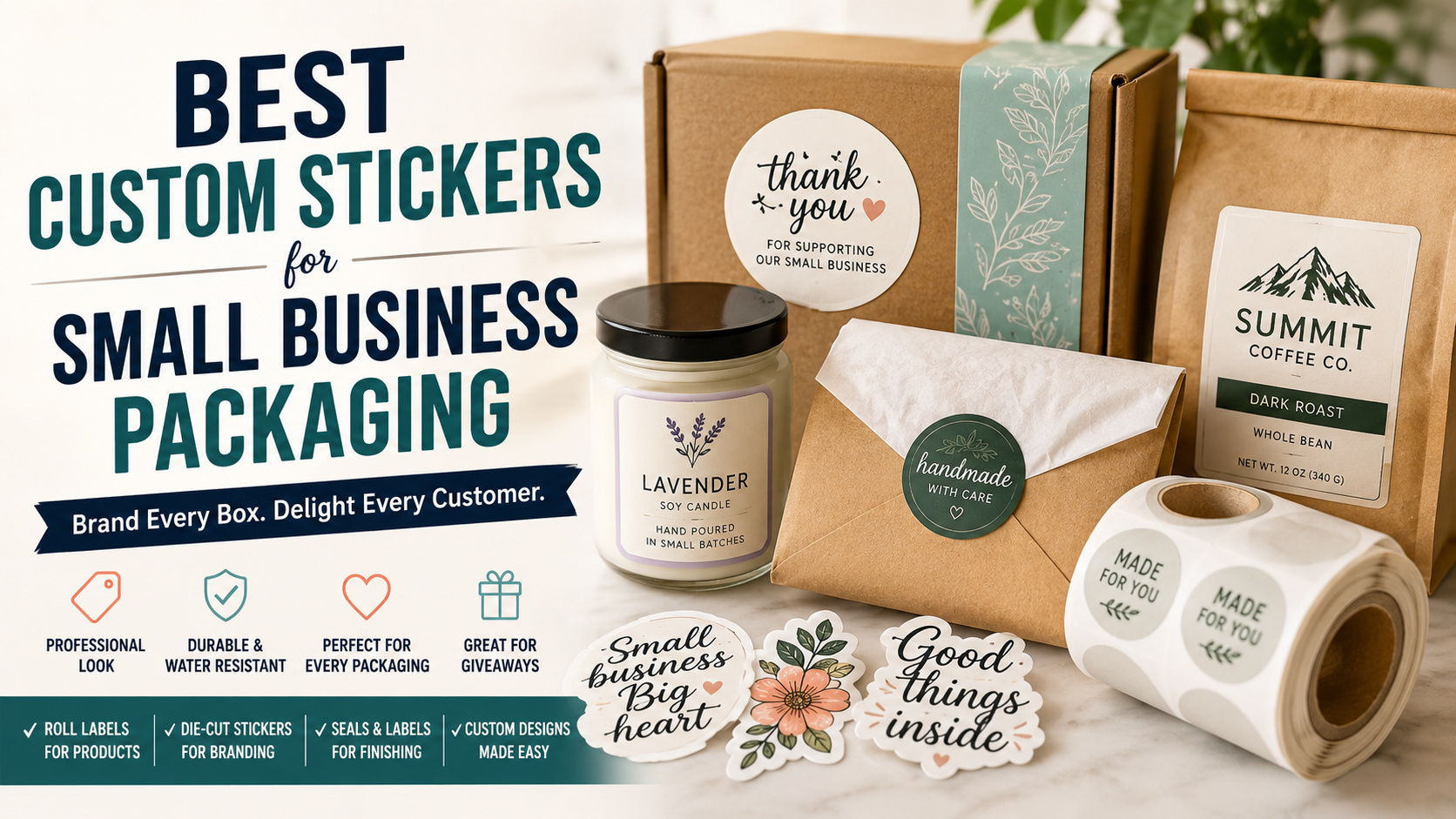
TLDR
- Use roll labels for repeated product labeling and high-volume packaging.
- Use die-cut stickers for logo stickers, package decorations, and customer giveaways.
- Use circle or rectangle stickers as simple*seals for tissue paper, boxes, and mailers.
- Choose clear stickers when you want the container or packaging material to show through.
- Use water-resistant vinyl for products exposed to condensation, moisture, oil, or frequent handling.
- Match the sticker to the packaging surface before choosing its shape, finish, or size.
Good packaging does not need to be elaborate.
A plain box, kraft mailer, glass jar, or simple paper bag can feel intentional once the right sticker is added. That is useful for small businesses because custom-printed packaging often requires large orders, extra storage space, and more money up front. Stickers let you brand packaging in smaller batches and update it without replacing every box or container you already own.
The best custom stickers for small business packaging do more than display a logo. They can seal tissue paper, identify product varieties, provide instructions, add a thank-you message, promote a social account, and give customers something they may actually keep.
The key is choosing the right sticker for each job.
The Best Packaging Stickers at a Glance
| Packaging Need | Best Sticker Type | Why It Works |
|---|---|---|
| Product branding | Roll labels | Quick to apply repeatedly |
| Box or mailer branding | Die-cut logo stickers | Custom shape creates a polished look |
| Tissue paper seals | Circle stickers | Simple, secure, and easy to center |
| Bottles and jars | Vinyl product labels | Better resistance to handling and moisture |
| Clear containers | Clear stickers | Keeps the package visible |
| Product variations | Small color-coded labels | Makes inventory easier to identify |
| Customer giveaways | Die-cut vinyl stickers | Durable enough to use on personal items |
| Instructions or safety information | Rectangle labels | Provides room for readable text |
| Seasonal packaging | Short-run custom stickers | Easy to change between campaigns |
| Multiple small designs | Sticker sheets | Combines several messages in one format |
There is no single sticker that handles every packaging task equally well. A large die-cut logo may look good on a shipping box but be inefficient for labeling hundreds of small jars. A roll label may be ideal for a bottle but less interesting as a free sticker inside the package.
Start with the job the sticker needs to perform. Then choose the material, shape, and finish.
Roll Labels Are Best for Repeated Product Packaging
Roll labels are usually the most practical option when you are applying the same design to many products.
The labels arrive on a roll rather than as individually cut pieces. That makes them easier to peel and apply during packing. You can keep a roll at a workstation, pull labels as needed, and avoid sorting through loose sticker backs.
Roll labels work especially well for:
- Candle jars
- Coffee bags
- Food containers
- Soap packaging
- Cosmetic bottles
- Mailers
- Bakery boxes
- Subscription boxes
- Product lids
- Shipping and inventory systems
CustomStickers.com describes its sticker rolls as a budget-friendly option for bulk packaging and retail use. The company also notes that roll labels are writable with permanent marker, which can help when adding batch numbers, scents, dates, initials, or other changing details.
Choose roll labels when speed and consistency matter. They are less useful when the sticker itself is intended to feel like merchandise or a customer gift.
Circle Roll Labels
Circle labels are one of the most flexible choices for small business packaging.
They can seal folded tissue paper, close bakery bags, brand jar lids, decorate cup tops, or sit neatly in the center of a small box. Circles also work well with short logos, monograms, icons, and simple thank-you messages.
Common sizes include:
- 1 inch: Small seals and product coding
- 1.5 inches: Tissue paper, envelopes, and small jars
- 2 inches: Boxes, bags, cups, and general product branding
- 2.5 to 3 inches: Larger containers and shipping packages
A two-inch circle is a safe starting point for many businesses. It is visible without taking over the package.
Rectangle Roll Labels
Rectangle labels provide more space for product information. They are often better than circles for ingredient lists, instructions, scent names, barcodes, warnings, and longer logos.
They work well on:
- Coffee bags
- Pouches
- Soap boxes
- Shipping cartons
- Candle containers
- Food tubs
- Bottles with a flat labeling panel
Rounded corners can help prevent the edges from snagging during handling. They also tend to look softer than sharp-cornered rectangles.
Die-Cut Stickers Make Simple Packaging Feel Custom
Die-cut stickers are cut around the shape of the artwork. A flower logo can follow the shape of the petals. A bakery sticker can resemble a loaf of bread. A mascot can be cut around the character rather than placed inside a square.
That shape creates more visual interest than a standard label.
Custom die-cut stickers work well for:
- Branded shipping boxes
- Poly mailers
- Paper shopping bags
- Product bundles
- Subscription boxes
- Event packages
- PR mailers
- Customer thank-you gifts
They are also useful when one sticker has two jobs. You can place a logo sticker on the outside of the package or include it loose inside the order as a giveaway.
CustomStickers.com says its die-cut stickers are individually cut to shape and recommends them for customer packaging, events, artists, and brand promotion. Its laminated vinyl is designed to resist water, scratches, and sunlight.
For packaging, most die-cut logo stickers do not need to be huge. A sticker between two and three inches on its longest side is large enough for many boxes and mailers.
Before ordering, check how the size is measured. CustomStickers.com bases the selected sticker size on the design’s longest side. A three-inch horizontal logo may be three inches wide but much less than three inches tall.
Logo Stickers Should Be Easy to Recognize
A packaging sticker has only a few seconds to communicate.
Customers should be able to recognize the business name or logo without rotating the package, squinting at small text, or deciphering a crowded background.
Strong logo stickers usually have:
- One clear focal point
- Readable lettering
- Good contrast
- Enough open space
- A shape that fits the artwork
- Limited supporting text
A website or social handle can be useful, but it should not compete with the logo. Long slogans, phone numbers, several social icons, and a QR code can make a small sticker difficult to read.
Think about viewing distance too. A design that looks clear while filling a computer monitor may become muddy at two inches wide. Print the design at its intended size before ordering and look at it from a few feet away.
Product Labels Need to Do More Than Look Good
Product labels often carry information the customer needs. That changes how they should be designed.
A decorative logo sticker can prioritize personality. A functional product label must prioritize clarity.
Depending on the product, the label may need room for:
- Product name
- Flavor or scent
- Net quantity
- Ingredients
- Directions
- Warnings
- Storage information
- Barcode
- Batch number
- Business contact details
Do not shrink required information until it technically fits. A larger label or a second back label is better than text customers cannot comfortably read.
For regulated products such as food, cosmetics, supplements, candles, or chemicals, confirm the labeling requirements that apply to the product before printing. A nice-looking label does not replace required information.
Custom product and packaging stickers use permanent adhesive and are described as resistant to water and oil. They can be ordered in custom sizes and shapes, with a proof supplied before production.
Vinyl Stickers Are Better Around Moisture and Handling
Paper labels can work well on dry boxes, bags, and indoor retail products. But they are less forgiving around water, oil, condensation, and repeated handling.
Vinyl stickers are usually the better option for:
- Beverage bottles
- Cold containers
- Bathroom products
- Skincare packaging
- Cleaning products
- Outdoor merchandise
- Frequently handled jars
- Products shipped in damp conditions
A laminate adds protection over the printed surface. It helps reduce scratching and shields the printed design from moisture and sunlight. CustomStickers.com describes its packaging stickers as thick vinyl with a weatherproof laminate coating.
The adhesive still needs a suitable surface. Packaging should be clean and dry before application. Moisture and condensation can interfere with adhesion, and chilled or frozen packaging may require materials made specifically for low-temperature application.
Apply labels before refrigerating a product whenever the packaging process allows it. This gives the adhesive time to bond to a dry surface.
Clear Stickers Create a Clean, Minimal Look
Clear stickers let the packaging material show through the design.
They can work especially well on:
- Glass jars
- Clear plastic bottles
- Transparent bags
- Windows in bakery boxes
- Acrylic containers
- White or brightly colored packaging
A clear label can make the printed design appear to be placed directly on the container. This is sometimes called a no-label look.
But clear stickers require careful design choices.
White areas in the original file may appear transparent unless white ink is specifically included. Light colors can also lose contrast against the product or container behind the sticker.
Before choosing clear material, ask:
- What color is the product?
- Will the container be empty or full?
- Is the sticker going on clear, white, or dark packaging?
- Does the design need white ink behind it?
- Will small text remain readable?
A black logo may look sharp on a clear glass jar filled with a light product but become difficult to see on a dark bottle.
Film label materials are commonly selected based on the container’s shape and flexibility. More rigid films are suited to flatter, rigid containers, while flexible films better follow squeezable bottles and curved surfaces.
Use Packaging Seals to Add Branding Without Custom Boxes
Packaging seals are a simple way to make standard materials feel intentional.
A sticker can close:
- Tissue paper
- Glassine bags
- Paper envelopes
- Bakery bags
- Product sleeves
- Small boxes
- Thank-you cards
- Wrapping paper
This works well for small businesses because the underlying packaging can remain neutral. The same kraft box or white mailer can be used across several product lines, while the sticker changes by collection, season, or campaign.
A seal does not need to include the full logo. It can use:
- A small icon
- A monogram
- A brand color
- A short thank-you message
- A seasonal graphic
- A product category
- A simple “packed for you” design
For tissue paper, a one-and-a-half- or two-inch circle usually provides enough coverage without tearing the tissue during opening.
Do not use an overly strong seal on packaging the customer needs to open cleanly. The sticker should hold the presentation together, not turn the unboxing into a minor test of strength.
Thank-You Stickers Add a Human Touch
A small thank-you sticker can make a package feel less anonymous.
Useful messages include:
- Thank you for your order
- Packed with care
- Made for you
- Thanks for supporting our small business
- We hope you love it
- Handmade in [city or state]
- Share your order with us
Keep the message short enough to read immediately.
Thank-you stickers can be placed on tissue paper, order receipts, interior box flaps, product cards, or the outside of a mailer. They can also close a handwritten note or printed packaging insert.
The goal is not to pretend every shipment includes a long personal letter. It is simply to show that a real business handled the order thoughtfully.
Include a Separate Sticker as a Customer Giveaway
One of the best packaging stickers may be the one you do not attach to the package.
A loose die-cut sticker gives the customer something they can place on a laptop, bottle, toolbox, notebook, phone case, or cooler. If the design is good, the customer may carry your brand far beyond the original order.
A giveaway sticker should be designed differently from a product label.
Avoid turning it into a tiny business card. A customer is more likely to use:
- A clean mascot
- A recognizable illustration
- A short phrase
- A strong logo
- A design related to the product
- A small collectible series
A candle company might make stickers based on different scents. A coffee shop might create a mug illustration rather than printing its full address. An outdoor brand might use a trail graphic that includes a small logo.
The sticker should connect to the business without feeling like an advertisement somebody is expected to display for free.
Sticker Sheets Work Well for Kits and Special Orders
Sticker sheets place several kiss-cut designs on one larger backing sheet.
They are useful for:
- Subscription boxes
- Children’s products
- Artist orders
- Craft kits
- Planner brands
- Seasonal collections
- PR packages
- Customer loyalty rewards
A sticker sheet can include a mix of logos, decorative elements, product icons, short messages, and small functional labels.
For example, a tea brand could include stickers for different moods or brewing times. A stationery company could include small decorative graphics that match the purchased collection.
Sticker sheets generally cost more per insert than a single small giveaway sticker, so they make the most sense for higher-value orders, special campaigns, or products where stickers are closely related to the brand.
Use Small Labels to Organize Inventory
Not every packaging sticker needs to face the customer.
Small labels can make packing easier by identifying:
- Sizes
- Colors
- Flavors
- Scents
- Product variations
- Batches
- Packing dates
- Quality checks
- Wholesale orders
- Subscription tiers
A candle business might use a different colored circle for each scent. An apparel brand could place size stickers on folded garments or storage bags. A coffee company could distinguish light, medium, and dark roasts with a simple color system.
CustomStickers.com recommends packaging stickers for organizing product variants, including scents, colors, flavors, sizes, and batches.
Keep internal systems simple. Five easily distinguished colors are usually more helpful than twelve similar shades that require a reference chart.
Matte vs. Gloss Packaging Stickers
Matte and gloss finishes can both work well. The best choice depends on the packaging and artwork.
Choose Matte When:
- The packaging uses kraft paper or natural materials
- You want a softer appearance
- The design uses muted colors
- You want less glare under store lighting
- The brand has a handmade or understated style
Choose Gloss When:
- The design uses bright colors
- You want stronger visual contrast
- The package has a polished or energetic look
- The sticker may be exposed to splashes
- Photographs or detailed illustrations are important
Gloss is not automatically more durable, and matte is not automatically more expensive-looking. The finish should support the design rather than trying to compensate for it.
How to Choose the Right Sticker Size
Measure the actual package rather than guessing.
A sticker that looks modest on a computer screen may dominate a small jar. Another may look substantial in a design file but disappear on a twelve-inch shipping box.
Use paper mockups before ordering:
- Print the sticker design at actual size.
- Cut around the shape.
- Tape it to the package.
- View it from several angles.
- Check whether curved edges cause lifting or distortion.
- Confirm that text and barcodes remain readable.
For round containers, avoid labels that are too wide for the available flat viewing area. Large labels may wrinkle or lift where the surface curves sharply.
And remember that size is often based on the longest side. A three-inch-wide rectangle may be only one inch tall.
Common Packaging Sticker Mistakes
Using One Sticker for Every Purpose
A product label, tissue seal, shipping-box logo, and customer giveaway do not need to be identical. Each has a different job.
Choosing Style Before Surface
The material must adhere to the package. Test plastics, textured boxes, curved bottles, oily containers, and chilled products before committing to a large order.
Making Text Too Small
Ingredient lists and instructions need to be readable. Increase the label size or divide information between front and back labels.
Applying Stickers to Dusty Boxes
Cardboard dust, oil, moisture, and cleaning residue can weaken adhesion. Wipe smooth surfaces and keep packaging dry.
Overloading the Design
A small sticker cannot comfortably hold a logo, slogan, website, QR code, phone number, address, social icons, and product description.
Ordering Too Many Seasonal Stickers
Evergreen logo stickers can be used year-round. Holiday messages, limited offers, and dated campaigns are safer in smaller quantities.
A Simple Small Business Packaging System
Most small businesses do not need seven sticker formats to get started.
A practical system might include:
- One roll label for the main product.
- One small circle sticker for tissue paper or package seals.
- One die-cut vinyl sticker for branding or customer giveaways.
- One rectangle label for ingredients, instructions, or warnings.
- Small color-coded labels for inventory variations.
Start with the pieces that solve real packaging problems. Add specialty finishes, sticker sheets, and seasonal designs once the core system is working.
Frequently Asked Questions
What Type of Sticker Is Best for Product Packaging?
Roll labels are usually best when applying the same label to many products. Die-cut stickers are better for custom shapes, prominent logos, and lower-volume packaging.
Are Vinyl Stickers Good for Packaging?
Yes. Vinyl is a strong choice for packages exposed to moisture, oil, scratching, outdoor conditions, or frequent handling. Dry paper boxes and bags may not always require vinyl, but it offers more protection than an uncoated paper label.
What Sticker Size Is Best for Packaging?
One-and-a-half to three inches works for many small business packaging uses. The correct size depends on the container, amount of information, artwork shape, and viewing distance.
Should Packaging Stickers Be Matte or Glossy?
Choose matte for a softer, low-glare appearance. Choose gloss for brighter colors and a shinier finish. Both can work when the sticker material and adhesive fit the package.
Can Stickers Replace Custom-Printed Packaging?
For many small businesses, yes. Stickers can brand standard boxes, mailers, jars, bags, and tissue paper without requiring a large order of custom-printed packaging.
Should I Put a QR Code on My Packaging Sticker?
Use a QR code when it leads somewhere useful, such as care instructions, reorder information, a tutorial, or a loyalty program. Test the printed code at its actual size before ordering.
Build the Packaging Around the Product
The best custom stickers for small business packaging make the package easier to identify, pack, open, and remember.
Use roll labels when you need speed. Choose die-cut stickers when shape and presentation matter. Use vinyl around moisture, clear material when the package should remain visible, and simple seals when standard packaging needs a branded finish.
Then keep the system manageable.
A clear product label, a neat package seal, and one good giveaway sticker can do more for a small brand than an overcomplicated package covered in five competing messages.