
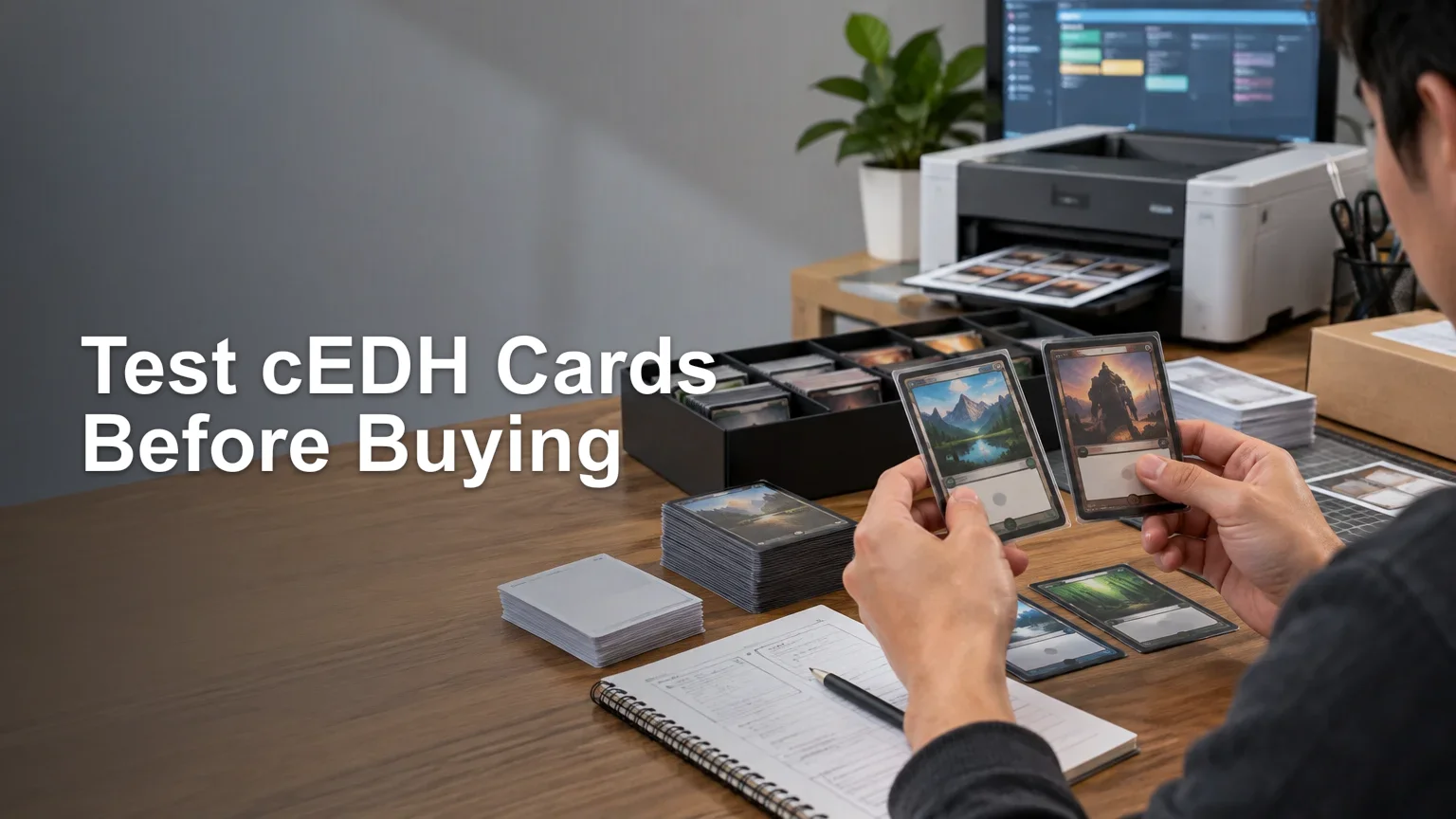
TLDR: The practical answer to how to use MTG proxies to test cEDH decks before buying expensive cards is to treat every stand-in as a temporary test instrument. Get consent, make each card clearly identifiable and obviously unofficial, test a small number of changes against a defined hypothesis, record what happened, and buy authentic cards only after the slots prove useful. Before attending a league or tournament, check its card policy directly.
An expensive card can look indispensable in a published decklist and still be wrong for your commander, local metagame, mulligan habits, or preferred lines. Proxies let you find that out before converting a deck-building assumption into a costly purchase. The useful goal is not to make a substitute resemble an authentic card; it is to make repeated testing easier while keeping every player clear about what is in the deck.
Can you use MTG proxies to test a cEDH deck?
Yes, in a consenting playgroup or an unsanctioned environment whose organizer permits them. Wizards distinguishes personal, non-commercial playtest cards from counterfeits and says it does not intend to police personal playtest cards outside sanctioned events. Its example includes a basic land clearly marked as another card. The Official Commander FAQ frames deviations from the baseline game through a Rule Zero discussion based on group consensus.
That does not create universal permission at stores, leagues, or tournaments. The Magic Tournament Rules require authorized cards in sanctioned events to be genuine, regulation-size Magic cards publicly released by Wizards, subject to the rules' stated exceptions. Player-created stand-ins are not generally permitted; the rules instead describe narrow situations in which tournament officials may issue a proxy for a particular event. Owning an authentic copy elsewhere does not, by itself, turn a player-created substitute into an authorized tournament card.
The operating rule is simple: ask the pod for casual games and ask the organizer for organized play. For sanctioned-event requirements, consult the current Magic Tournament Rules rather than relying on a social-media post or an old event policy.
Keep playtest cards separate from counterfeits
Players often use “proxy” as a catch-all term, but the distinctions matter. In this workflow, a personal playtest card is a clearly unofficial stand-in used to evaluate a deck. A counterfeit is made or presented in a way that could mislead someone into believing it is an authentic product. Wizards treats those categories differently.
Build the distinction into the physical card. Use an unmistakably unofficial back, a prominent “PLAYTEST” label, or a visibly different layout. Include enough information for opponents to identify the card without repeatedly stopping the game: name, mana cost, card type, major rules text, power and toughness where applicable, and the intended printing or version if that affects comprehension.
Do not add authentic-looking security features, collector details, or other elements intended to create confusion. A custom back also reduces the chance that a loose test card will be mistaken for a genuine card outside its sleeve; the operational value of custom card backs is identification, not imitation.
Abbreviated text can be fine when everyone knows the card, but keep the current Oracle wording available. The Tournament Rules recognize Oracle as the official card text, so an old image or shorthand label should not settle a rules dispute.
Start with a legal target list
A proxy does not make an otherwise illegal deck legal. Commander decks contain exactly 100 cards including the commander, follow the commander's color identity, and generally allow only one copy of each nonbasic card. Check the current Commander rules and applicable card-legality information before testing so that you do not optimize a list you cannot play.
Save a dated baseline list before making changes. Record the commander, all 99 cards, the cards being removed, and the proposed replacements. If you use a dedicated MTG proxy resource to prepare test pieces, keep the decklist itself as the source of truth. The physical stack will change frequently; the documented list tells you what was actually tested.
Test one to three slots against a hypothesis
Changing fifteen cards at once may improve the deck, but it rarely tells you which changes mattered. A better iteration block changes one to three related slots and begins with a specific prediction.
- “This additional fast-mana card will produce more useful turn-one plays without creating too many weak late draws.”
- “This land will improve color access, but I need to see whether its drawback interferes with early interaction.”
- “This tutor will find the winning line often enough to justify its mana cost and opportunity cost.”
- “This interaction spell will be live against the threats my regular opponents actually present.”
- “This combo piece will reduce setup requirements rather than becoming another card that is poor on its own.”
Write the hypothesis before playing. Otherwise, it is easy to remember the one spectacular game and ignore several games in which the card was stranded, redundant, mistimed, or worse than the card it replaced.
Use goldfishing and multiplayer games for different questions
Goldfishing means playing opening hands and early turns without opponents. It is useful for mechanical questions: color access, mulligans, sequencing, tutor paths, combo assembly, and whether a new card creates awkward hands. It is not reliable evidence that a line survives interaction or that spending resources on it is correct in a four-player game.
Use short goldfish repetitions to catch obvious problems, then move the list into real multiplayer games. Keep opposing decks representative of the environment where you expect to play. If possible, avoid changing both your test slots and the entire opponent field at the same time.
There is no official number of games that proves a card belongs. Choose a test block that gives the card repeated opportunities to matter, then extend it when the results are dominated by unusual draws, early concessions, or games in which the test card was never seen. The aim is not statistical certainty; it is a purchase decision based on more than one memorable outcome.
Test card categories by the job they perform
Fast mana
Do not score fast mana only by whether it creates an explosive opening. Track whether the extra speed changes what you can accomplish, whether it exposes you to a punishing exchange, and whether the card remains useful when drawn later. Compare complete sequences, not merely the amount of mana produced.
Lands and color fixing
Log opening colors, untapped sources, keepable hands, and turns where a land's condition or drawback changes your play. A premium land may improve one narrow sequence while contributing little elsewhere. Conversely, a modest improvement in first-turn color access can matter repeatedly in a deck with demanding interaction.
Tutors
Record what the tutor finds in practice. If it always searches for the same combo piece, evaluate its role in that package. If it alternates between mana, protection, interaction, and a win condition, its flexibility may be the central benefit. Include the mana and timing needed to cast both the tutor and its target.
Interaction
Track whether the spell had a legal target, whether you could hold up its cost, and whether it answered the threat that mattered. Also note when another effect would have been better. An interaction card can be powerful in general but poorly aligned with your regular pods.
Combo pieces and support cards
Separate cards that are useful independently from cards that function only inside a winning line. When testing a narrow piece, record how often you draw it without access to the rest of the combo and what resources are needed to convert it into a win attempt. That identifies the deck-building cost of the package, not just its ceiling.
Keep a short cEDH card-test log
A useful log should take less than two minutes after a game. If it becomes burdensome, it will not survive many sessions. Capture observations rather than trying to reconstruct every turn.
- Date, pod, and broad opponent archetypes
- Starting hand and mulligan count
- Test cards drawn, tutored for, milled, or otherwise encountered
- Turn and board state when each test card became relevant
- What the card replaced in the baseline list
- Whether it improved a decision, enabled a line, or sat unused
- Interaction that stopped the plan
- Result of the game, without treating the result as the only score
- Keep, cut, or retest decision and a one-sentence reason
Game wins are noisy. A test card can perform its job in a loss, and a deck can win despite a weak inclusion. Judge the card against its hypothesis: Did it improve the decisions or sequences it was added to improve?
Swap cards cleanly as the list evolves
Iteration creates a version-control problem. Number each test batch and store removed cards separately from the active deck. Update the digital list immediately after accepting a change, not several sessions later. If two stand-ins use similar art or abbreviations, label them so opponents can distinguish them across the table.
A simple status system keeps the purchasing queue honest: “testing” for cards in the current block, “provisional” for cards that passed but need more varied games, “approved” for cards that earned a permanent slot, and “rejected” for cards removed with a recorded reason. This prevents a previously rejected idea from returning without new evidence.
For a broader discussion of responsible proxy use and pod expectations, see why clearly disclosed playtest cards can be practical in cEDH.
When has a card earned a purchase?
An expensive card has earned serious purchase consideration when it repeatedly performs its assigned role, remains useful across relevant matchups, fits the deck's mana and sequencing constraints, and survives comparison with less costly alternatives. You should also be confident that the surrounding package is stable. Buying a premium combo piece makes less sense while you are still questioning the combo itself.
Use four decision checks:
- Role: Can you state exactly what the card does for this deck?
- Evidence: Did it matter across multiple relevant games rather than one exceptional draw?
- Replacement: Did it outperform the card or category it displaced?
- Use requirement: Do you need an authentic copy for the sanctioned events or store policies you intend to enter?
Passing those checks does not mean you must buy immediately. Availability, condition, edition, and budget still matter. It means the deck-building question has been answered: the slot is proven enough that a purchase would support a stable plan rather than an untested assumption.
Run a final event check
Before taking the finalized deck to organized play, contact the organizer and determine whether the event is sanctioned, what card policy applies, and whether decklists or card checks are required. Do not assume that a store's casual Commander night, its league, and a cEDH tournament all use the same policy. Unsanctioned proxy-friendly events and sanctioned events operate under different constraints.
Replace player-created stand-ins with authorized cards wherever the applicable rules require it. Then verify the physical deck against the final list: 100 cards including the commander, correct color identity, legal cards, no accidental duplicates, consistent sleeves, and current card text available for any unfamiliar interaction.
Make the purchase the last step, not the experiment
The strongest proxy-testing workflow is deliberately unglamorous: establish permission, label every stand-in, freeze a baseline list, change only a few slots, log what those cards actually do, and keep iterating until the answer is stable. Start your next session with one expensive card and one written hypothesis. If the card earns its slot under real pressure, then decide whether the authentic copy is worth adding to the finalized deck.