
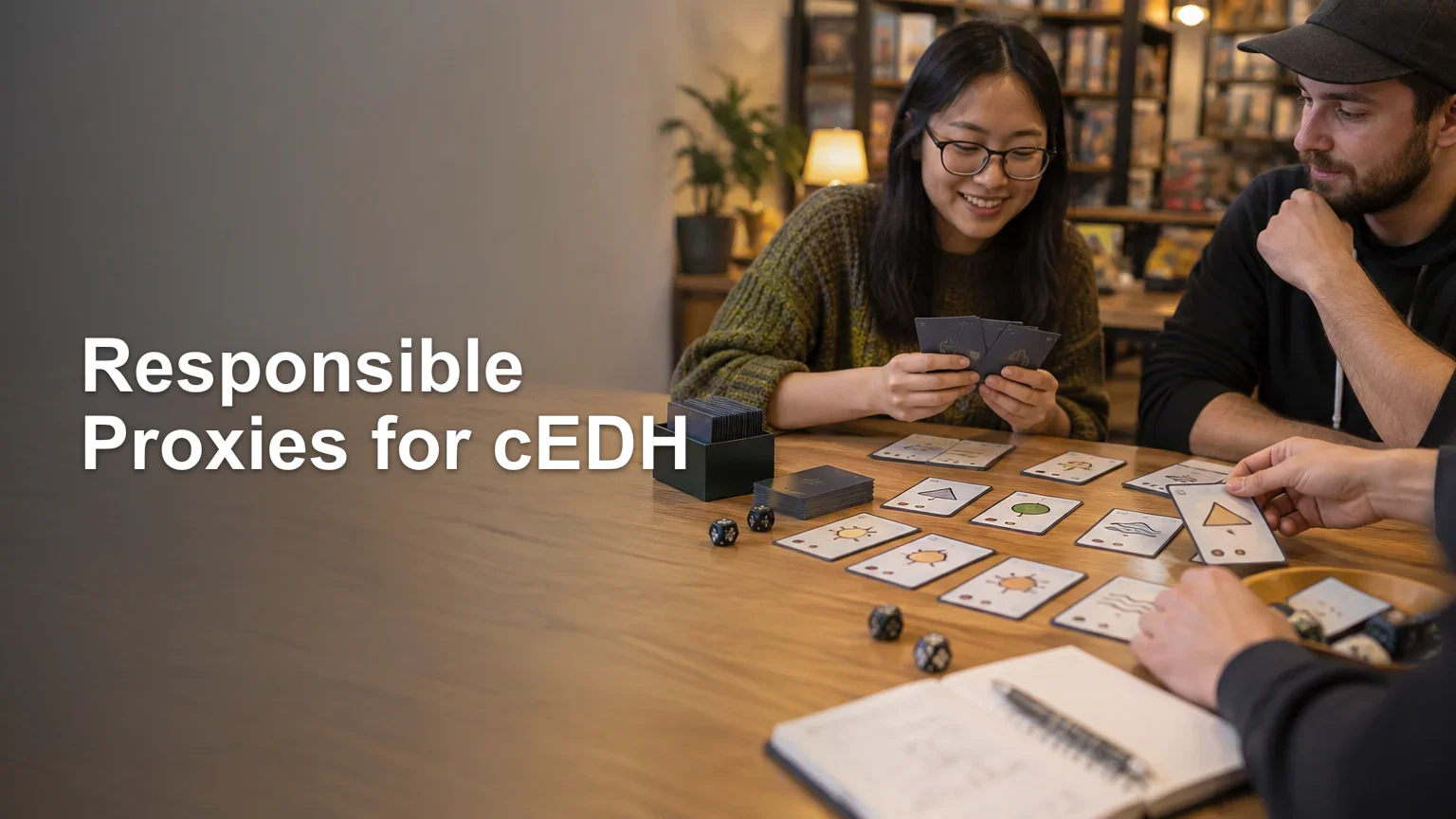
TLDR: Why I recommend MTG proxies for cEDH comes down to testing and access. Clearly disclosed personal playtest cards let a consenting group evaluate deck construction and gameplay without making card ownership the entry requirement. That recommendation does not extend to sanctioned tournaments, deceptive copies, or any table where the organizer or players have not agreed to their use.
The best policy is simple: ask first, make every stand-in obviously unofficial, keep the deck readable and physically consistent, and follow the organizer’s rules. If an event is sanctioned, player-created proxies are not permitted under the current Magic Tournament Rules. Those rules generally require genuine, publicly released Magic cards and reserve tournament proxies for narrow, judge-managed circumstances. Read the current Magic Tournament Rules before entering a sanctioned event.
What “MTG proxy” means in this recommendation
The word “proxy” causes confusion because players use it for several different things. Wizards acknowledged this broad community usage in a 2016 policy article, noting that the term can refer to everything from marked-up playtest cards to counterfeits. Tournament rules use the term more narrowly.
Here, I am recommending a personal playtest stand-in: an unmistakably unofficial card used with the informed consent of the other players. It represents a card mechanically during a game, but nobody claims that it is genuine, tournament legal, collectible, or suitable for resale.
That is different from a counterfeit. A counterfeit is made or presented in a way that can lead someone to believe it is an authentic product. Wizards’ buyer-safety guidance warns that proxy copies of valuable cards are not original cards, while its Fan Content Policy says its fan-content permission does not include creating or distributing counterfeit or proxy Magic cards. This article is not legal advice or guidance for reproducing official artwork, trademarks, card frames, or security features.
| Term | Working meaning here | Practical boundary |
|---|---|---|
| Personal playtest card | An unofficial stand-in used to test gameplay | Disclose it and obtain permission before play |
| Tournament proxy | A substitute issued by a judge under limited tournament-rule circumstances | Players cannot issue these for themselves |
| Counterfeit | A non-genuine item represented or liable to be mistaken as genuine | Do not make, trade, sell, or present one as authentic |
| Genuine card | An authentic Magic card released by Wizards | Required in sanctioned play, subject to the tournament rules and their stated exceptions |
Why I recommend playtest cards for cEDH
Competitive Commander asks players to evaluate an entire system, not just a list of individually strong cards. A deck has to develop resources, interact at useful times, advance a win, recover from disruption, and operate against three opponents. A card that looks essential in a decklist may prove awkward once the deck is played repeatedly.
Playtest cards make that learning cycle easier. Instead of treating a proposed list as a finished purchasing decision, a player can treat it as a working configuration: build, play, record problems, revise, and repeat. This is especially useful when comparing cards that occupy the same functional slot.
A testing session might investigate questions such as:
- Can the opening hands reliably advance the deck’s plan?
- Does the deck have the right balance of acceleration, interaction, card selection, and win conditions?
- Are situational cards getting stranded in hand?
- Can the deck function after its first plan is disrupted?
- Does a proposed change improve difficult matchups, or does it only look good in ideal games?
- Is the pilot consistently using a card well enough to justify its slot?
The value is not that playtest cards automatically produce a better deck. They reduce the friction between a hypothesis and an actual game. Players still need representative opponents, repeated games, honest notes, and disciplined revisions. For broader deck-construction context, the guide to Commander card draw by archetype explains how a card’s role depends on the strategy around it.
The social case depends on consent
In a consenting pod, disclosed playtest cards can shift the competition toward deckbuilding, sequencing, threat assessment, and piloting rather than collection access. That is an editorial value judgment, not a measurable outcome guaranteed for every group. Some players enjoy games where everyone can test the configuration they intend to play. Others prefer authentic-card-only tables or events. Neither preference authorizes one player to decide for everyone else.
Consent must be specific to the setting. Approval in a private testing group does not imply approval at a local store, league, tournament, or another private table. Ask before arriving if possible. At minimum, disclose the stand-ins before shuffling and give the other players a genuine opportunity to decline.
A useful pregame statement is direct: “This deck contains clearly marked personal playtest cards. Is everyone comfortable with that here?” If the answer is no, use a different deck or do not enter that game. Debating someone into reluctant acceptance is not meaningful consent.
Sanctioned and unsanctioned events require different checks
The first question for an organized event is not whether it is described as cEDH. Ask whether it is sanctioned and request the written card policy.
For sanctioned tournaments, the February 27, 2026 Magic Tournament Rules state that cards generally must be genuine Magic cards publicly released by Wizards, subject to specified exceptions. Players may not create their own proxies. A judge may issue a tournament proxy only in defined circumstances, such as when an otherwise legal card is damaged during the event or certain limited product is defective.
An independently run, unsanctioned event may publish different participation rules, but there is no universal cEDH policy that answers the question for every store or organizer. Verify the event’s status, ask whether personal playtest cards are allowed, and confirm whether there are limits or identification requirements. Do not infer permission from an event’s power level, entry fee, prize structure, or casual branding.
| Setting | Safe default | What to verify |
|---|---|---|
| Sanctioned tournament | Bring genuine cards that comply with current tournament rules | Event status, format legality, card condition, and sleeve requirements |
| Independent unsanctioned event | Do not assume permission | Organizer policy, any limits, and required markings |
| Local store game or league | Ask the store and the pod | Whether different nights or events use different policies |
| Private testing session | Agree before building the pod | Which stand-ins are acceptable and how they should be identified |
Make every permitted stand-in table-ready
Permission is the minimum. A responsible playtest deck should also be easy to read, difficult to mistake for a genuine collection, and physically consistent enough that no card can be identified from the back or by touch.
- Disclose the stand-ins before the game. State approximately how many are present if the group or organizer wants that information.
- Make them unmistakably unofficial. Avoid designs, backs, labels, or presentation that could cause confusion with genuine cards. The discussion of why custom card backs matter for MTG proxies covers this identification problem in more detail.
- Prioritize gameplay information. Players should be able to identify the represented card and obtain its current Oracle text when exact wording matters.
- Use opaque, consistent sleeves. Different wear, thickness, transparency, orientation, or sleeve style can make a card identifiable in the library.
- Check physical consistency. A stand-in should not create a detectable bend, edge, or thickness difference that reveals its position.
- Keep a current decklist available. This helps resolve ambiguity and lets the group confirm what each stand-in represents.
- Never trade or sell a stand-in as genuine. Keep unofficial cards separate from authentic inventory when transporting, sorting, or sharing a collection.
The sleeve point is operational, not cosmetic. Tournament rules address marked cards and sleeve patterns because identifying a card without seeing its face can create an advantage. Even in an unsanctioned testing game, consistent sleeves protect the integrity of the exercise.
Use proxies to test questions, not avoid decisions
A playtest deck produces better information when the session has a purpose. Before playing, identify one or two uncertainties. Perhaps you are comparing two interaction packages, testing whether the deck keeps enough opening hands, or determining whether a slower value card survives at the table’s pace.
Record outcomes without overinterpreting one game. A simple testing note can include the opening hand, mulligan decision, turns when the deck lacked mana or interaction, cards that remained unused, the attempted win line, and the reason the game ended. After several games, look for repeated failure modes rather than memorable highlights.
Change a small number of slots at a time when possible. Replacing a large portion of the list makes it hard to identify which change affected performance. The goal is a controlled revision loop:
- Define the question.
- Choose the cards or package being evaluated.
- Play under the group’s agreed conditions.
- Record recurring constraints and dead draws.
- Revise the smallest useful set of cards.
- Repeat before deciding whether the configuration is worth keeping.
This approach also helps separate deck problems from pilot problems. Sometimes a card is correct but unfamiliar. Sometimes the deck contains enough card advantage on paper but cannot access it at the right stage of the game. Testing gives the player a chance to learn that distinction before treating any list as final.
Commander Brackets do not create blanket proxy permission
Commander Brackets are intended to support expectation-setting through pregame conversation. The official Commander page describes Brackets 4 and 5 as focused on higher-power or competitive play, but that classification concerns the kind of game players expect—not a universal card-authenticity policy. The official Commander format page explains the bracket system and its role in pregame discussion.
Calling a deck Bracket 5 therefore does not make personal playtest cards automatically acceptable. It also does not override sanctioned tournament rules, a store policy, an independent organizer’s conditions, or another player’s decision. Power-level alignment and proxy permission are separate conversations.
The practical recommendation
I recommend clearly disclosed personal playtest cards for cEDH when the objective is serious testing and everyone involved has agreed to them. They let players revise decks, practice lines, and evaluate card choices before treating a list as settled.
The boundaries matter as much as the benefit: confirm the event status, obtain permission, make every stand-in obviously unofficial, maintain readable gameplay information, use physically consistent sleeves, and never represent a non-genuine card as authentic. For sanctioned play, follow the current tournament rules and bring genuine cards unless a judge issues a permitted tournament proxy under those rules.
The next step is not to assume that “cEDH” answers the policy question. Ask the organizer or pod, get a clear answer, and build your testing process around that answer. Consent first; useful testing second.