
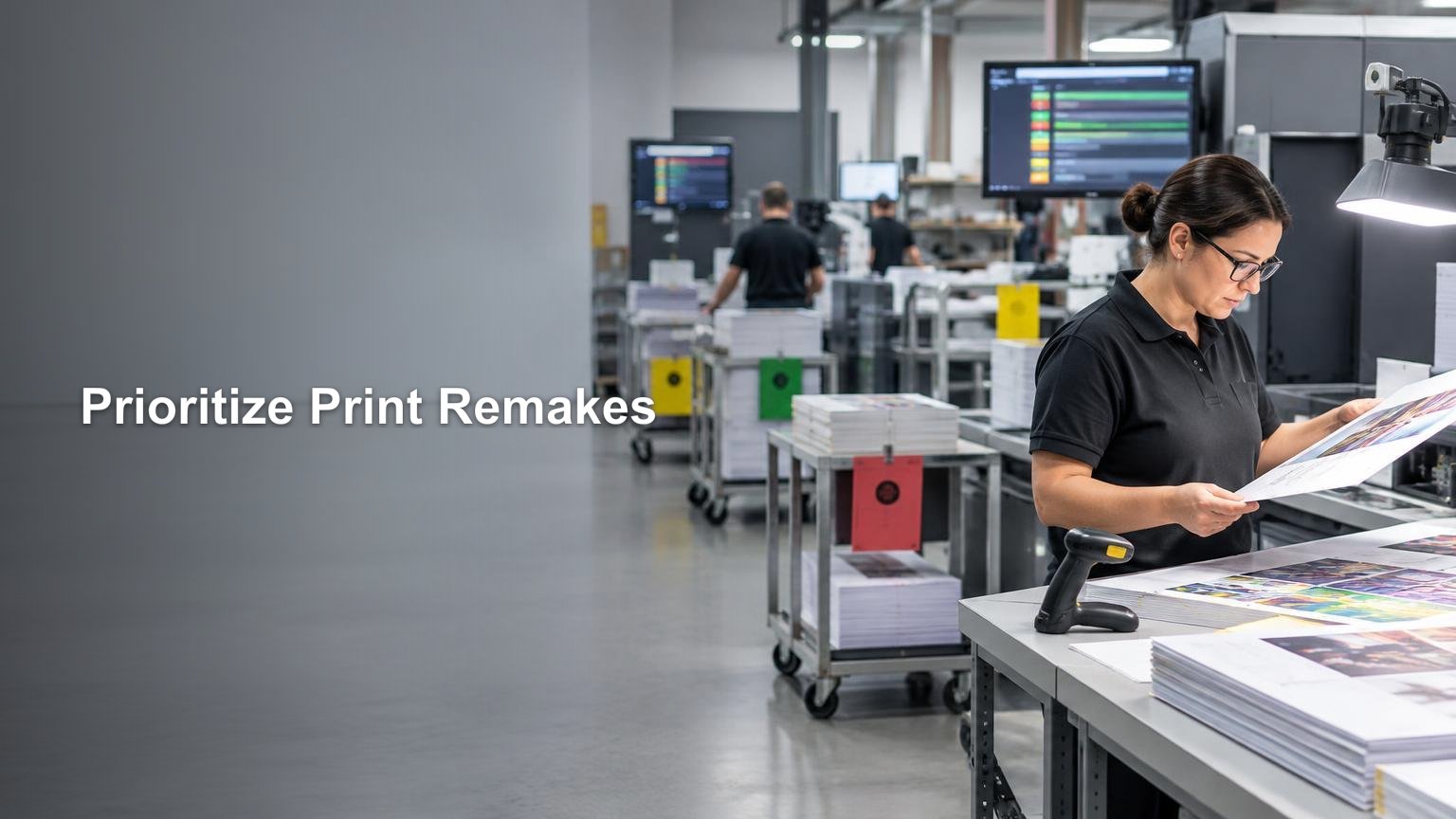
How to Prioritize Remakes Without Derailing New Production
TLDR
A reliable print remake priority workflow does not send every defective job to the front of the queue. It first contains possible exposure, classifies the defect, selects a disposition, and then assigns a priority based on customer harm, recovery time, systemic risk, resource constraints, and material readiness. Protect new production with a separate remake queue, explicit authorization rules, work-in-process limits, and complete records linked to the original job.
The goal is not merely to complete remakes quickly. It is to recover the right jobs without hiding failure demand inside the normal schedule. When defect evidence, direct costs, causes, and corrective actions stay attached to each remake, the same workflow also reveals where the operation is losing quality and capacity.
Start by containing the problem, not by scheduling it
When a defect appears, the first question is not “Where can we squeeze in the reprint?” It is “What else could be affected?” A wrong artwork revision might apply to other orders released from the same file. Banding could affect output produced under the same press condition. A pack-out error could extend across every carton completed under the same instruction.
Temporarily hold related work when there is a credible shared risk. Define the scope by checking the approved file, production settings, material lot, equipment condition, finishing setup, personalization data, packing instructions, and jobs processed in the same window. The hold should name an owner and a release condition so it does not become invisible stranded work.
This containment step separates an isolated damaged item from a process problem. An isolated item may need a partial remake. A repeated variable-data mismatch may justify stopping related jobs until the data source or mapping is corrected.
Classify the defect before choosing a disposition
Use observable defect classes rather than vague labels such as “bad print” or “customer issue.” A useful defect taxonomy can include wrong artwork revision, personalization mismatch, wrong SKU or material, color or uniformity failure, registration error, finishing defect, quantity shortage, packing damage, destination error, and post-handoff damage.
For print inspection, color, registration, and general print quality are distinct conditions worth recording. PRINTING United Alliance also identifies output conditions such as streaking and banding in its press-sheet uniformity material. Its press-sheet inspection context is a useful reference when defining observable print-condition codes.
| Defect class | Likely disposition options | Reason to escalate |
|---|---|---|
| Wrong artwork or revision | Hold, partial remake, or full remake | The same released file may affect other jobs |
| Variable-data mismatch | Hold and investigate; remake affected records | A data or mapping error may repeat across the run |
| Wrong material, size, or finish | Rework if conversion is still possible; otherwise remake | The setup or pick error may affect the remaining batch |
| Color, banding, or registration defect | Adjust and verify, then remake affected quantity | An unstable process may continue producing defects |
| Finishing or cut error | Rework where safe and compliant; otherwise remake | Shared tooling or settings may affect more work |
| Quantity or component shortage | Produce only the missing quantity when traceability permits | The count or pack-out method may be unreliable |
| Packing or handling damage | Replace affected pieces and inspect related cartons | The damage mechanism may still be active |
| Shipping-label or destination issue | Correct before handoff when possible; hold if destination is uncertain | Misrouting can create customer and recovery exposure |
| Cause not yet established | Hold pending investigation | Scheduling before containment can reproduce the defect |
After classification, choose one disposition: rework in place, partial remake, full remake, hold for decision, or a documented alternate resolution. Rework is appropriate only when it restores the product to the approved requirement without creating another uncontrolled condition. A partial remake is preferable when the affected units can be identified reliably. A full remake becomes necessary when the affected population cannot be separated or the entire output is nonconforming.
Build a print remake priority workflow around exposure
A remake should interrupt scheduled production only when the cost or harm of waiting is greater than the disruption caused by the interruption. Make that decision from visible criteria rather than whoever complains most loudly.
- Customer commitment exposure: Is a promised ship date, event, installation, or coordinated delivery at risk?
- Recoverability: Can the job still reach packing or carrier handoff if it enters production now?
- Severity: Is the problem cosmetic, functional, identity-related, destination-related, or potentially harmful to the customer’s use?
- Systemic-risk potential: Could the same file, setting, material, device, or instruction affect more jobs?
- Constrained-resource impact: Does recovery require a bottleneck press, cutter, finisher, specialist, or pack station?
- Readiness: Are the approved file, correct material, replacement data, labor, and shipping instructions actually available?
- Cost of delay versus disruption: What is lost by waiting, and what scheduled work would be displaced by acting now?
Do not collapse these factors into a universal numeric formula. Their relative importance changes by shop and product. A wrong-address shipment may be more urgent than a visible print flaw if carrier handoff is minutes away. A severe print defect may still remain on hold if the corrected artwork has not been approved.
Use priority bands that describe the required response
| Band | Use it when | Scheduling treatment |
|---|---|---|
| P1: Immediate or systemic | There is serious commitment exposure, high customer harm, or credible risk that the active process is producing more defects | Contain affected work, authorize the interruption, and control the affected resource immediately |
| P2: Recover today | The job can still meet a meaningful cutoff and all release inputs are ready | Insert at the next controlled opening without bypassing required checks |
| P3: Planned recovery | The remake can be completed inside the remaining lead time | Schedule visibly alongside new work and reserve the required material and route |
| P4: Compatible batch | The remake has low immediate exposure and can share material, setup, finishing, or packing with planned work | Batch it at the next compatible run while preserving traceability |
| Hold | Cause, scope, approval, material, file, data, or customer decision is unresolved | Do not release until the named condition is satisfied |
Each band needs a response expectation, an authorized owner, and an escalation path defined by the shop. Avoid using P1 as a synonym for “customer complained.” Priority should represent operational exposure, not simply the source of the request.
Protect new production from remake queue creep
Remakes become disruptive when they enter production as side conversations, handwritten notes, or edits to the original job. Give every remake a separate job ID linked to the original. Preserve the original specifications while recording the corrected release inputs and affected quantity.
The remake should move through the same visible production controls as other work. A controlled ecommerce print production workflow is especially important when a replacement must reconnect with packing, carrier acceptance, and tracking. White-label operations also need the remake record to preserve brand-specific packing and communication rules; the broader white-label fulfillment workflow shows where those controls belong.
- Assign one decision authority for displacing scheduled work during each shift.
- Require a reason code, disposition, owner, and release condition before the remake enters the queue.
- Set a visible work-in-process limit for remakes waiting at constrained equipment.
- Use planned flex capacity or an approved override rather than quietly overloading the schedule.
- Display holds separately from production-ready work.
- Recalculate downstream effects when a remake consumes cutting, finishing, QC, packing, or carrier-cutoff capacity.
- If internal recovery cannot meet the requirement, evaluate an approved external route, including suitable printing options from Printiverse, as an alternate disposition rather than an untracked workaround.
Flex capacity is a policy, not a universal percentage. The right allowance depends on demand variability, defect history, product mix, bottleneck utilization, staffing, and service commitments. If reserved capacity repeatedly goes unused, it may be excessive. If remakes routinely displace promised work, it may be inadequate or the underlying defects may need stronger corrective action.
Place quality checks where they prevent expensive discovery
A remake workflow recovers defects; quality checkpoints reduce how often recovery is needed. Place checks before additional value, material, or time is added. A practical route may include preflight and release approval, a risk-appropriate first-piece check, verification after a critical printing or finishing step, and final order and pack-out verification.
Not every product needs the same checkpoint or inspection instrument. Match the control to the failure mode. Artwork version and personalization belong near file release. Registration, color, and uniformity belong near print setup and process monitoring. Cut position belongs after finishing setup. Quantity, components, destination, and presentation belong at pack-out. The detailed quality control checkpoint workflow can help define these gates, while disciplined artwork file organization reduces ambiguity about which approved revision should be produced.
After an incident, tighten the relevant inspection until the process is demonstrably stable. That might mean checking every affected unit for a limited recovery batch or adding targeted checks at the point where the defect originated. Document what triggers a return to normal inspection.
Use sampling only as a defined control
Sampling is not an instruction to inspect a convenient handful. A defensible plan defines the lot, defect classes, inspection method, acceptance and rejection rules, escalation response, and recordkeeping. ISO 2859-1:2026 describes lot-by-lot attribute sampling schemes indexed by acceptance quality limit and includes switching rules that adjust inspection severity according to quality history. Review the ISO 2859-1 standard overview before adopting a formal acceptance-sampling system.
Do not borrow an AQL or sample size without confirming that it fits the product, risk, and contractual requirements. Use 100% inspection when the consequence of an escape is high, the process is unstable, the affected units must be individually identified, or the lot cannot support the assumptions of the sampling plan. Sampling becomes more useful when the process is stable, the lot is defined, and the escalation rules are established in advance.
Document the remake as a nonconformance record
The minimum useful record connects what failed, what was done, what it cost, and whether the response prevented recurrence. Include the original and remake IDs, affected quantity, product and route, work center, defect code, evidence, discovery point, containment action, disposition, priority, owner, recovery date, and customer or shipping exposure.
Add direct-cost fields for replacement substrate or blanks, ink or consumables, production labor, setup time, machine time, finishing, QC, packing materials, replacement freight, and disposal where applicable. Keep direct remake cost separate from harder-to-measure effects such as lost contribution from displaced work or customer-service time. Consistency matters more than pretending every indirect cost can be measured precisely.
A correction and a corrective action are not the same thing. Reprinting the job corrects the immediate nonconforming output. Changing a release control, maintenance method, training step, file rule, or production setting to address the cause is corrective action. ISO 9000 guidance supports documenting nonconformities, retaining evidence, and checking whether corrective action was effective. The ISO 9000 terminology and guidance provides the underlying quality-management context.
Turn remake records into trend data
Review remake data on a regular operating cadence. Weekly review is useful for active containment and capacity decisions; a longer monthly view helps distinguish repeated patterns from isolated events. Segment results by product, production route, work center, material, shift, defect class, discovery checkpoint, and pack-out profile where the data volume supports it.
- Remake rate, with the unit of comparison clearly defined
- First-pass yield: jobs or units completed without correction or remake
- Direct remake cost
- On-time recovery rate
- Defect escapes discovered after the intended checkpoint
- Repeat defects after a corrective action was implemented
- Constrained-capacity hours consumed by remakes
- Defects by discovery point, especially those detected late in finishing or pack-out
Use the review to choose a small number of actions with owners and verification dates. If wrong revisions dominate, strengthen artwork release and archive controls. If damage clusters at packing, inspect materials, handling, station layout, and instructions. If registration defects recur on one route, investigate the equipment, setup method, substrate interaction, and operator controls rather than treating each remake as unrelated.
Effectiveness must be verified after implementation. Look for recurrence under comparable conditions, not merely completion of the action item. If the same defect returns, reopen the cause analysis or revise the control.
A reusable remake release checklist
- Contain potentially related work and identify the possible scope.
- Record the observable defect class and attach evidence.
- Choose rework, partial remake, full remake, hold, or an approved alternate resolution.
- Confirm the corrected file, data, material, quantity, route, and packing instructions.
- Assign a priority from defined exposure criteria.
- Name the person authorizing any displacement of scheduled production.
- Create a separate remake job linked to the original record.
- Reserve the constrained resources and calculate downstream schedule effects.
- Define the inspections required for release and recovery.
- Capture direct costs, cause, corrective action, and the effectiveness-check date.
Make urgency visible instead of contagious
A good remake system does not eliminate urgent work. It prevents urgency from spreading through the entire schedule. Contain first, classify the observable defect, choose the least disruptive valid disposition, and let defined exposure criteria determine whether the job interrupts new production.
The practical next step is to create one shared remake record and five visible queue states: P1, P2, P3, P4, and Hold. Run the system for a defined review period, then examine which defect classes consumed the most direct cost and constrained capacity. That turns remakes from hidden schedule noise into evidence for better production control.